
A practical guide to specifications custom options factory pricing samples and bulk quality control
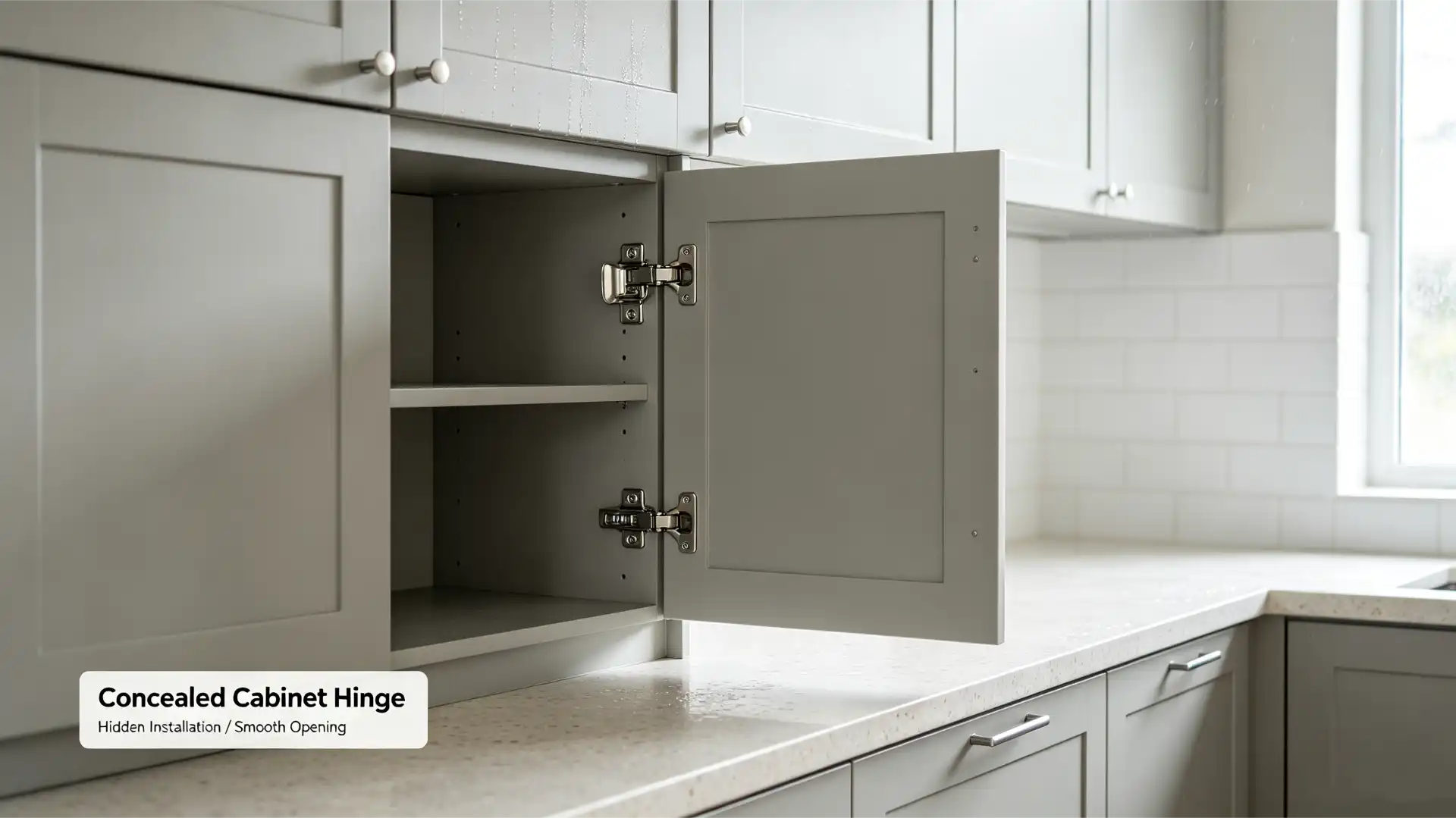
Concealed hinges support a clean exterior while allowing cabinet manufacturers to adjust door fit from inside the cabinet.
OEM concealed cabinet hinges for cabinet manufacturers should be selected as part of the cabinet system, not as an isolated hardware item. Door position, panel thickness, mounting plate, opening angle, adjustment range, closing action, material, finish, and production method all affect installation and long-term performance.
This guide explains how cabinet factories can define a hinge specification, compare custom options, understand factory pricing, approve samples, and inspect bulk orders. It covers concealed hinges as a product family, including standard and soft-close models, different overlay arrangements, special opening angles, adjustable systems, and material choices.
Why Hinge Selection Affects Cabinet Production
A concealed hinge connects two manufactured parts that both contain tolerances: the cabinet body and the door. A hinge can operate smoothly in a sample display yet create alignment problems on a production line if the cup drilling, mounting-plate position, door weight, or screw engagement differs from the approved setup.
For cabinet manufacturers, a suitable hinge specification can shorten adjustment time, support consistent door gaps, and reduce avoidable replacement claims. The purchasing team therefore needs more than a product photo and unit price. It needs a drawing, an agreed installation condition, a representative sample, and measurable acceptance criteria.
Define the Cabinet Before Choosing the Hinge
Start with the cabinet structure and door movement. This gives the supplier enough information to recommend an existing model or identify where a custom design is needed.
Door position and cabinet construction
State whether the door is full overlay, half overlay, or inset, and whether the cabinet is frameless or face frame. These details affect the hinge-arm geometry, mounting plate, setback, and available adjustment. If one furniture program includes several door positions, list each configuration separately rather than asking one hinge to cover every cabinet.
Door dimensions and weight
Provide the door height, width, thickness, material, and estimated weight. A tall, wide, glass, or dense-board door may require a different hinge quantity or structure than a small standard door. The cabinet manufacturer and hinge supplier should agree on the installation layout and test method for the finished application.
Opening angle and internal clearance
Confirm the required opening angle and check for adjacent walls, corner cabinets, drawers, pull-out baskets, and internal fittings. Standard applications often use a common opening range, while corner and special cabinets may need a wider or restricted angle. UKLINK’s current hinge range includes several angle-specific and adjustable options, so the RFQ should describe the cabinet movement rather than naming an angle without a drawing.
Closing action and installation method
Specify whether the cabinet needs self-closing, integrated soft-close, or another closing behavior. Also confirm clip-on or fixed attachment, screw or dowel fixing, adjustment directions, cup diameter and depth, drilling pattern, and mounting-plate height. These details influence both assembly speed and replacement compatibility.
Common Concealed Hinge Configurations
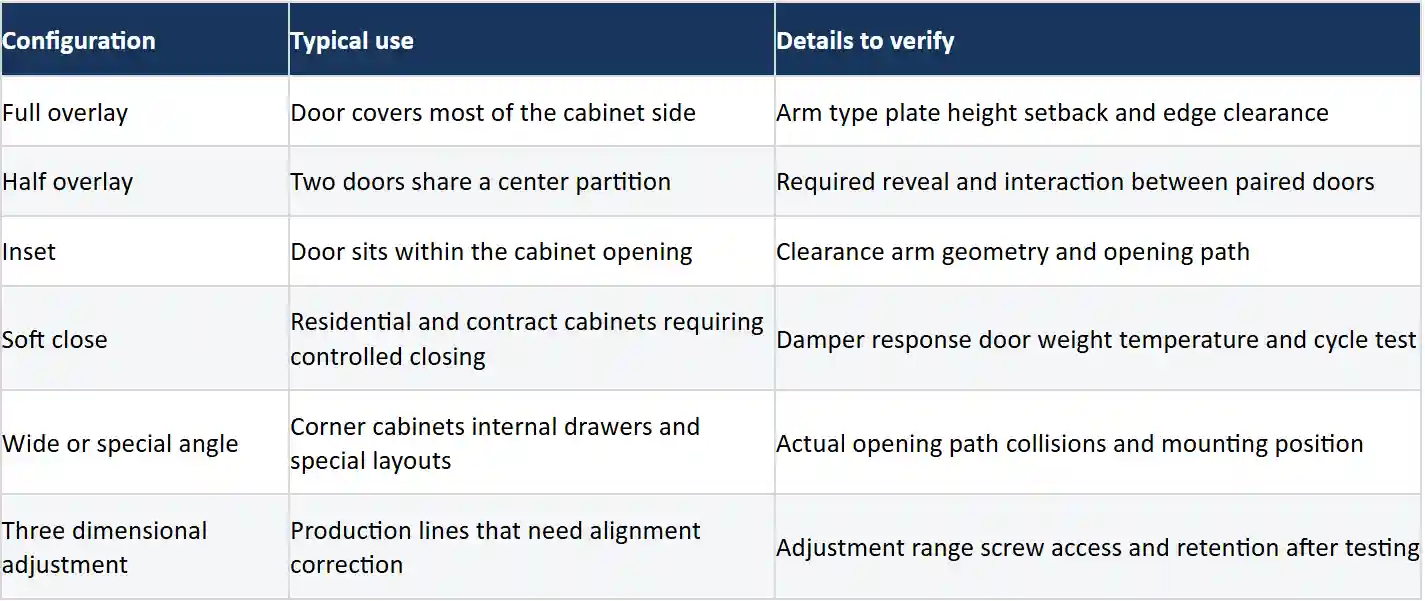
Review UKLINK’s concealed cabinet hinge range to compare available opening angles, soft-close structures, materials, and adjustment options before preparing the RFQ.
OEM and ODM Options for Cabinet Factories
Custom concealed cabinet hinges for furniture factories may begin with an existing production model or a new design brief. OEM work is appropriate when the buyer already has a drawing, reference sample, drilling pattern, or private-label specification. ODM support is useful when the buyer defines the cabinet application, target performance, market position, and cost target but needs help selecting or refining the hinge.
Possible customization areas should be confirmed model by model. They may include:
- Hinge arm geometry, mounting plate, overlay position, and opening angle.
- Cup and plate drilling patterns that match the cabinet production line.
- Cold-rolled steel or stainless steel construction based on the application and price tier.
- Soft-close mechanism, adjustment structure, and assembly method.
- Surface finish and appearance reference, including approved color and gloss limits.
- Logo marking, labels, hardware kits, inner packing, carton marks, and private-label packaging.
Before paying for tooling, record drawing ownership, tooling charges, revision limits, sample quantity, approval criteria, production tolerances, and whether any development fee can be credited to a future order. A signed drawing and approved sample should control the bulk specification.
Carbon Steel and 304 Stainless Steel
The source article compared plated carbon steel with 304 stainless steel for African coastal kitchens. That distinction remains useful for global buyers, but the final material choice should follow the actual humidity, salt exposure, cleaning chemicals, transport conditions, warranty target, and budget of each cabinet program.
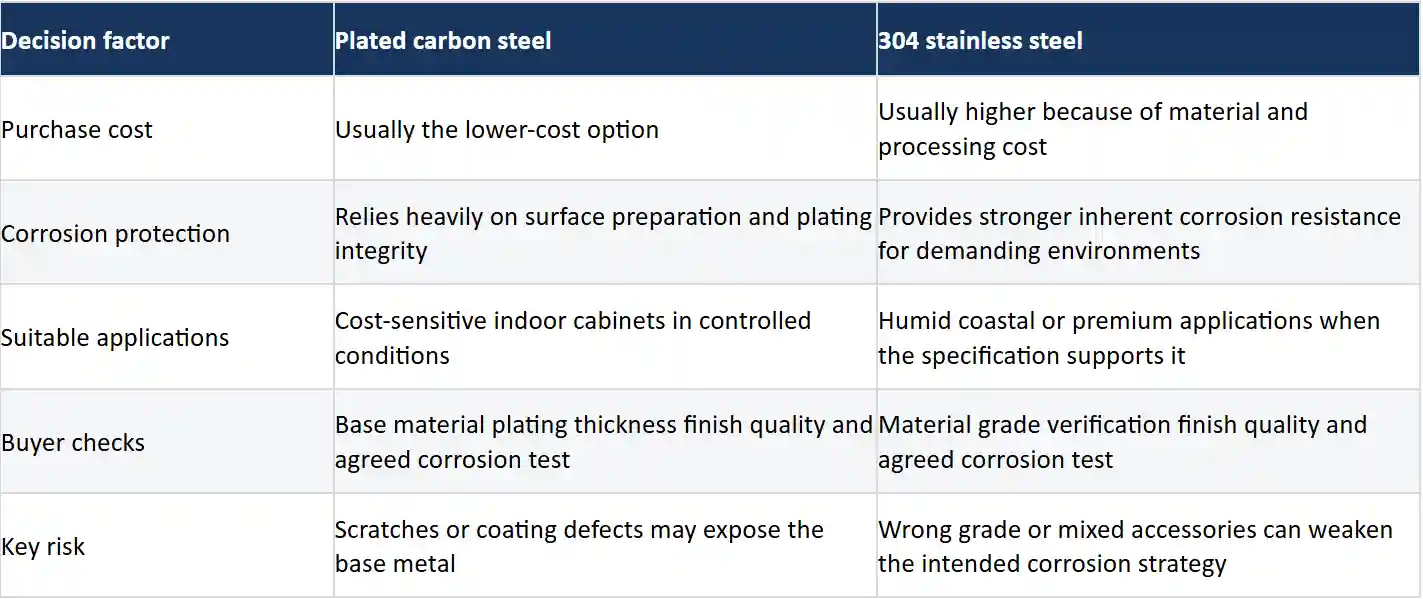
Do not select material by name alone. Screws, mounting plates, rivets, and other connected parts also affect the installed system. Define any corrosion or salt-spray requirement through an agreed test method, duration, sample condition, and acceptance criterion rather than using a vague claim such as rustproof.
How Factory Pricing Is Calculated
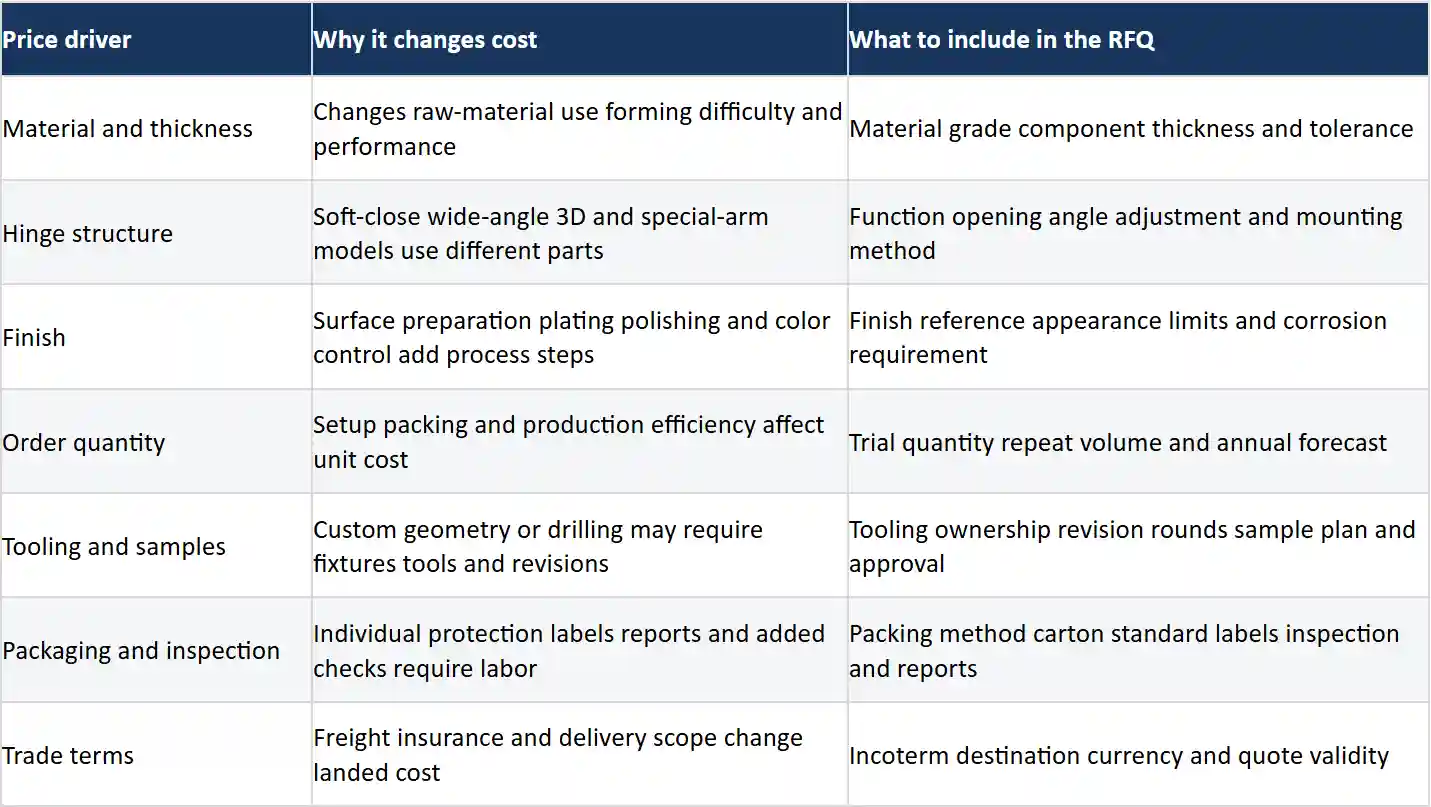
A request for concealed cabinet hinges factory price for bulk orders should describe one complete specification. Otherwise, two quotations may look comparable while including different materials, hinge weights, damping structures, packaging, inspection levels, or trade terms.
Ways to Control Cost Without Weakening the Specification
- Start with an existing hinge platform when its geometry fits the cabinet and test target.
- Standardize cup drilling and mounting plates across cabinet ranges where the design allows.
- Separate mandatory performance requirements from optional appearance or packaging features.
- Limit the number of finishes in the first order and add variants after demand is proven.
- Give realistic trial and repeat volumes so the supplier can quote useful price breaks.
- Approve the complete hardware kit and packaging before production to avoid late changes.
The lowest unit price can become expensive if it increases line adjustment, damaged finishes, mixed components, rework, or after-sales replacements. Compare suppliers on the same specification and calculate the cost of installation and quality risk as well as the purchase price.
Prepare an RFQ That Can Be Quoted Accurately
The following information lets an OEM concealed cabinet hinge supplier recommend a suitable model and identify true customization work:
- Cabinet type, door position, application, and target market.
- Door height, width, thickness, material, weight, and expected hinge quantity.
- Dimensioned cabinet and door drawings, including drilling and mounting positions.
- Required opening angle, closing action, adjustment, and attachment method.
- Material, finish, corrosion requirement, and appearance reference.
- Trial quantity, annual forecast, packaging, labeling, destination, and trade terms.
- Required documents, inspection plan, test method, and target delivery schedule.
Sample Approval Before Mass Production
Install samples on the real cabinet or a production-equivalent fixture. A loose sample opened by hand cannot confirm drilling compatibility, door gaps, screw access, closing behavior, or interaction with adjacent fittings.
- Check dimensions, drilling pattern, plate position, and fastener engagement against the drawing.
- Confirm full overlay, half overlay, or inset alignment across the intended adjustment range.
- Open and close the actual door to review smoothness, damping, clearance, and rebound.
- Inspect finish color, gloss, scratches, burrs, sharp edges, and visible assembly defects.
- Run the agreed load, cycle, corrosion, or transport tests under recorded conditions.
- Approve packaging, labels, screws, plates, and all components supplied with the hinge.
- Record every revision before signing the drawing and reference sample.
Bulk Quality Checks Before Shipment
Pre-shipment inspection should compare production with the signed specification and approved sample. Draw samples from different cartons and production positions, and record the sampling method used.
- Dimensions, cup and plate geometry, hole positions, arm alignment, and visible deformation.
- Material and component thickness according to the purchase specification.
- Plating or surface defects, color variation, scratches, burrs, and contamination.
- Opening, closing, soft-close response, adjustment, screw retention, and abnormal noise.
- Installation on a representative cabinet fixture and any agreed performance test.
- Quantity, mixed models, accessories, labels, inner protection, carton marks, and carton condition.
A Practical OEM and ODM Buying Process
- Send the cabinet brief, drawings, application, target market, quantity, and cost position.
- Review existing hinge models before requesting a new tool or structure.
- Confirm the quotation scope, technical specification, tooling, samples, and trade terms.
- Approve drawings, finish references, packaging, and installed samples.
- Use agreed quality checkpoints during production and before shipment.
- Record first-order feedback and lock the approved specification for repeat orders.
Why Cabinet Manufacturers Work With UKLINK
UKLINK HARDWARE states that it was founded in 2010 and developed from a furniture-hardware plating specialist into an integrated manufacturer covering product development, production, sales, and customer service. Its website presents a hinge range that includes multiple opening angles, soft-close models, stainless and cold-rolled steel options, and adjustable structures.
For OEM and ODM projects, UKLINK offers customization in design, packaging, and production. Its factory and supply-chain model is positioned around competitive pricing, consistent quality, and export support. Final capability, price, minimum quantity, sample terms, testing, and lead time should be confirmed against the requirements of each project.
Frequently Asked Questions
What information is needed for a concealed hinge quotation?
Provide the cabinet and door drawings, door position, dimensions, weight, drilling pattern, opening angle, closing action, material, finish, quantity, packaging, destination, and trade terms.
Can one concealed hinge fit every cabinet door?
No single hinge should be assumed to fit every door. Overlay position, cabinet construction, door dimensions, weight, opening path, and drilling pattern determine compatibility.
Should cabinet factories choose carbon steel or 304 stainless steel?
Plated carbon steel can be suitable for cost-sensitive indoor applications, while 304 stainless steel may be preferable for humid, coastal, or premium programs. Verify the complete specification and test conditions.
What can be customized in an OEM or ODM hinge project?
Possible areas include geometry, mounting plate, drilling pattern, material, finish, damping, logo, labels, hardware kits, and packaging. Feasibility depends on the selected model and order requirements.
Why are concealed hinge quotations different?
Material, thickness, structure, finish, quantity, tooling, packaging, inspection, and trade terms all affect price. Compare quotations only after these items are aligned.
Should buyers approve samples before a bulk order?
Yes. Install the sample on the real cabinet, verify the drawing and functions, complete the agreed tests, and approve the packaging before mass production.
Request a Quote and Samples
Prepare your cabinet drawing, door information, required hinge functions, material and finish, expected quantity, target market, packaging needs, and delivery schedule. This allows the supplier to recommend a suitable existing model or define the development work for a custom project.
Ready to review a project? Request a concealed cabinet hinge quotation or sample from UKLINK HARDWARE.