
A practical guide for furniture manufacturers, cabinet and wardrobe brands, and wholesale buyers in the Middle East, Southeast Asia, Eastern Europe, and India.
Quick answer: Choose a supplier that can confirm dimensions, finish standards, samples, packaging, pricing terms, and inspection requirements before production. A low unit price only creates value when the handles arrive consistent and ready for assembly or resale.
Furniture handles are small components, but they influence furniture appearance, daily use, assembly efficiency, and the buyer’s impression of quality. For a factory or wholesale program, the sourcing decision also affects rework, stock consistency, packaging, and repeat-order reliability.
If you are comparing a furniture handles manufacturer for OEM ODM projects, do not judge suppliers by product photos or a single quotation alone. The better approach is to compare specifications, customization support, sample approval, quality checkpoints, and total landed value. This guide explains what to verify and how to prepare a quotation request that produces useful, comparable offers.
What B2B Buyers Should Verify Before Choosing a Manufacturer
1. Product specifications that can be repeated
A handle must fit the furniture program, not only look attractive in a catalog. Ask the supplier to confirm the material, overall length, projection, center-to-center hole spacing, screw specification, weight, finish, color tolerance, and packaging method. For standardized cabinet or wardrobe production, even a small variation in hole spacing can slow assembly or create field complaints.
Use a signed drawing, approved sample, or detailed specification sheet as the production reference. If you need replacement-compatible sizes, state the existing drilling pattern clearly instead of relying on a product name such as “modern pull” or “cabinet handle.”
2. Materials and finishes suited to the application
Stainless steel, zinc alloy, aluminum, brass, and other materials can all be appropriate, depending on the design, price point, finish, weight, and intended use. The right choice for a high-volume wardrobe range may differ from the right choice for premium kitchen cabinetry or hospitality furniture.
Discuss the expected environment and cleaning conditions. For kitchens, bathrooms, humid coastal markets, or heavy-use commercial projects, ask how the finish will be evaluated. Where durability is important, agree on the relevant test method and acceptance criteria before ordering rather than using vague terms such as “good quality” or “rustproof.”

3. Sample approval and change control
A pre-production sample helps confirm shape, hand feel, dimensions, finish, and packaging. The approved sample should be linked to a written specification so that both parties know what the bulk order must match. If a finish, screw, logo, or package changes after approval, record the revision and confirm whether it affects price or delivery.
4. Quality checkpoints for bulk orders
Wholesale and factory buyers need consistency across cartons and repeat orders. Ask which checkpoints apply to incoming materials, dimensions, surface finish, assembly, and final packaging. For larger orders, agree on an inspection method, sampling level, defect categories, and the documents or photos required before shipment.
This is especially important for matched collections. A visible color difference between handles used on adjacent doors can be more damaging than a minor variation hidden inside the package.
5. Pricing that reflects total project cost
Competitive pricing matters, but buyers should compare like with like. A quotation should identify the material, finish, size, order quantity, tooling or mold charges, logo or packaging costs, sample charges, trade terms, and quotation validity. If two prices use different materials or surface processes, the lower number may not represent the lower total cost.
For furniture factories, also consider the cost of inconsistent hole spacing, mixed finishes, missing screws, damaged cartons, or late specification changes. Reliable specifications can protect production schedules and after-sales margins even when the initial unit price is not the absolute lowest.
OEM vs. ODM Furniture Handles: Which Cooperation Model Fits?
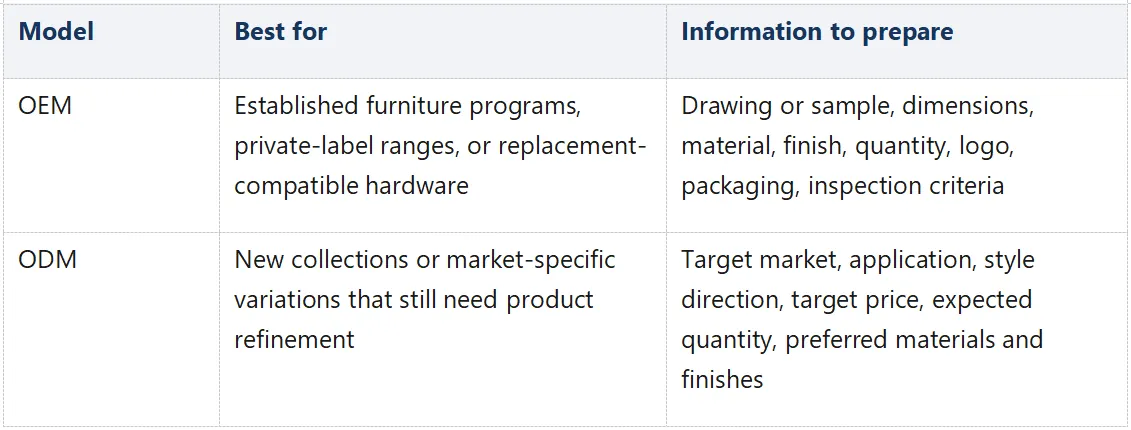
OEM cooperation is usually suitable when the buyer already has a confirmed drawing, sample, specification, logo, or packaging requirement. The manufacturer produces according to the approved requirements. ODM cooperation is useful when the buyer has a market need or design direction but wants help refining the handle, finish, size, or presentation before production.
A custom furniture handles manufacturer for furniture brands should explain which features can be changed using existing tooling and which changes require new tooling. This distinction can significantly affect sample cost, development time, minimum order requirements, and the final unit price.
How to Control Cost Without Sacrificing Consistency
A wholesale furniture handles supplier for cabinet factories should be able to discuss cost drivers openly. Buyers can often improve value by standardizing specifications and making decisions earlier in the sourcing process.
- Consolidate sizes and finishes where the furniture collection allows it.
- Use common center-to-center dimensions to simplify drilling and replacement.
- Confirm whether existing designs or tooling can meet the target look before commissioning a new mold.
- Compare pricing at realistic order quantities instead of requesting an unrealistically low trial quantity and applying that price to future volume.
- Finalize logo, screws, labels, inner packaging, and export cartons before the bulk quotation is approved.
- Ask for separate costs when optional customization makes the quotation difficult to compare.
Adapting the Range for Different Target Markets
The Middle East, Southeast Asia, Eastern Europe, and India are diverse markets, so a single regional stereotype is not a sourcing strategy. Validate the preferred styles, finishes, price tiers, packaging language, and channel requirements with your own distributors, retail customers, or furniture program managers.
Still, the sourcing process can remain consistent across regions: define the customer segment, application, target price, expected annual volume, finish expectations, and packaging needs. Then ask the manufacturer to propose options against that brief. This produces a more useful shortlist than selecting products only from visual trends.
A Six-Step Furniture Handle Sourcing Workflow
- Define the application. List the furniture type, target customer, market, price position, and expected quantity.
- Prepare the specification. Confirm dimensions, center-to-center spacing, material, finish, screws, logo, and packaging.
- Request comparable quotations. Send the same brief to each shortlisted manufacturer and ask suppliers to identify assumptions.
- Review samples. Check fit, appearance, hand feel, installation, finish, and packaging against the written requirements.
- Approve production standards. Sign the drawing or sample and confirm inspection criteria, delivery terms, and change control.
- Evaluate the first order. Record defects, assembly feedback, packaging performance, and customer response before the repeat order.
Questions to Ask a Furniture Handles Manufacturer
- Which materials, finishes, sizes, and center-to-center dimensions are available?
- Which parts of the handle, screws, logo, and packaging can be customized?
- Can you work from drawings, physical samples, or a design brief?
- Which changes require new tooling, and which can use an existing design?
- What details are included in the quoted unit price, and which costs are separate?
- How are pre-production samples approved and retained as references?
- Which quality checks are performed before shipment?
- What information do you need to quote the project accurately?
Why Consider UKLINK HARDWARE
UKLINK HARDWARE supplies furniture handles and supporting furniture hardware for B2B buyers. The company supports OEM/ODM cooperation for furniture manufacturers, cabinet and wardrobe brands, importers, and wholesalers that need product selection and customization support.
For price-sensitive programs, UKLINK HARDWARE can review the target application, specifications, expected quantity, and customization requirements before preparing a quotation. This helps buyers compare suitable options without separating price from material, finish, packaging, and project scope.
Request a Quote or Samples
Prepare your inquiry: Send the handle style or reference, dimensions, center-to-center spacing, preferred material and finish, estimated quantity, target market, logo or packaging needs, and expected delivery schedule.
Contact UKLINK HARDWARE to request product information, discuss an OEM/ODM furniture handle project, obtain a quotation, or arrange samples before bulk production.
Frequently Asked Questions
Can furniture handles be customized for a private-label collection?
Yes, depending on the product and project. Common customization points may include dimensions, hole spacing, finish, logo, screws, labels, and packaging. Confirm feasibility, tooling, quantity, and cost before approving the design.
Should buyers request samples before a bulk order?
For a new supplier, finish, size, or custom project, a sample is an important approval step. Link the approved sample to a written specification so that the bulk standard is clear.
How should furniture handle prices be compared?
Compare quotations using the same material, finish, dimensions, quantity, packaging, trade terms, and inspection expectations. Separate tooling and optional customization costs where possible.
What information is needed for an accurate quotation?
Provide the application, style or product reference, dimensions, center-to-center spacing, material, finish, quantity, target market, logo or packaging needs, and delivery requirements.
What is the difference between OEM and ODM furniture handles?
OEM production follows the buyer’s confirmed design or specification. ODM cooperation includes more support in developing or adapting a product concept for the buyer’s market or brand.