
1.Understanding the Real Difference Between 201 and 304 Stainless Steel Handles
When purchasing stainless steel furniture hardware, especially stainless steel furniture handles, many buyers focus mainly on appearance and price. However, for professional furniture manufacturers, wholesalers, and project suppliers, the most important factor is not only how the handle looks when new, but how it performs after months or years of use.
This is especially important for markets with challenging environments, such as coastal areas in the UAE, South Africa, and other regions exposed to high humidity and salt air.
Among stainless steel furniture handles, 201 and 304 stainless steel are two commonly used materials. They look very similar after polishing, making it difficult for ordinary buyers to identify the difference through visual inspection alone.
However, from the perspective of material composition, corrosion resistance, and long-term durability, the performance gap between them is significant.
Choosing the wrong stainless steel grade may lead to:
- Surface rust problems
- Customer complaints
- Product replacement costs
- Project delays
- Damage to supplier reputation
Therefore, understanding the difference between 201 and 304 stainless steel handles is essential for anyone involved in furniture hardware sourcing.
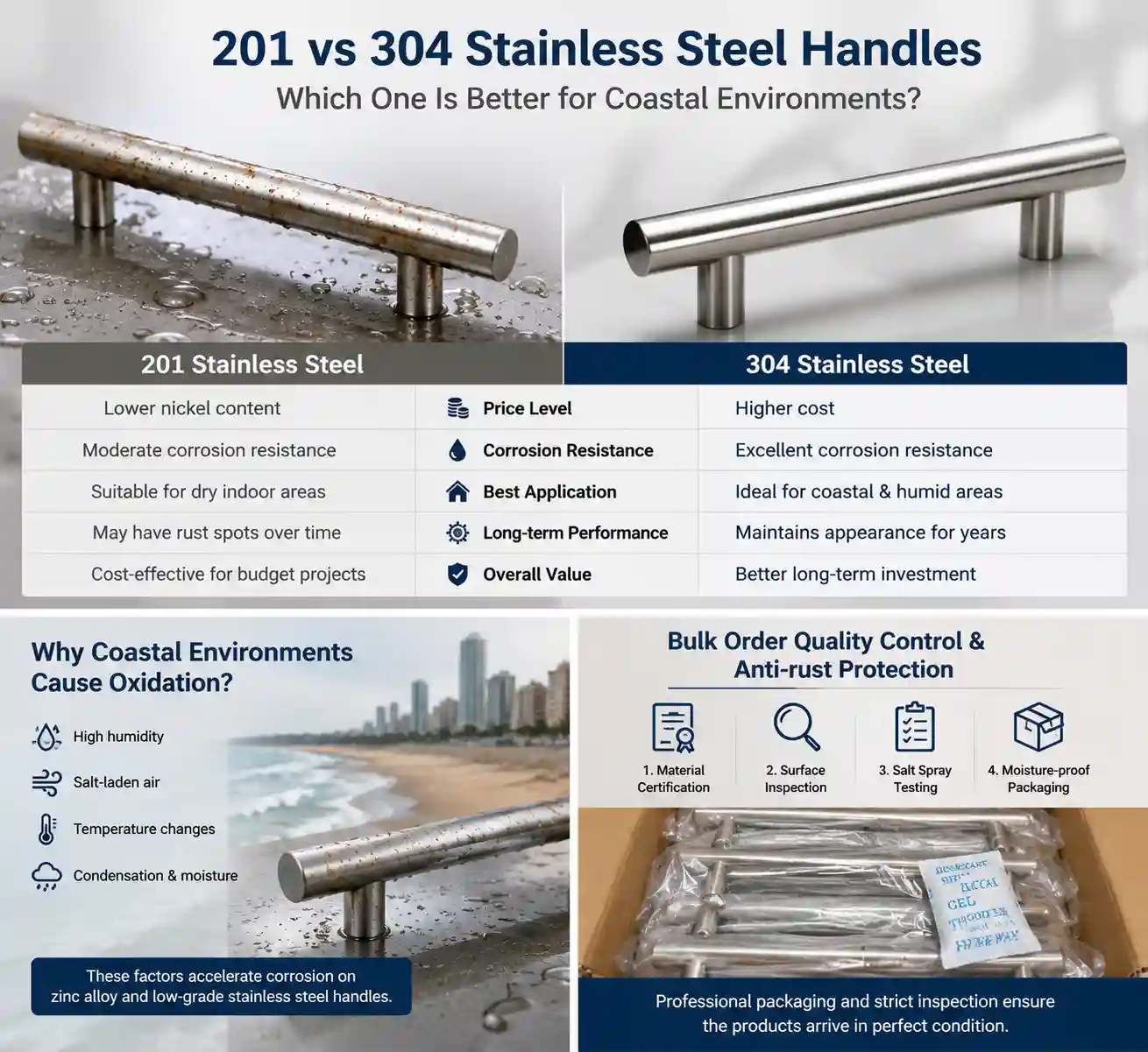
2.201 Stainless Steel Handles: Cost Advantage with Limited Corrosion Resistance
201 stainless steel is often selected as a more economical alternative to 304 stainless steel.
The main reason is its material composition. Compared with 304 stainless steel, 201 stainless steel contains less nickel and uses a higher proportion of manganese to reduce production costs.
This makes 201 stainless steel more affordable and attractive for price-sensitive projects.
For furniture hardware applications, 201 stainless steel handles are commonly used in:
- Budget furniture production
- Large-volume residential projects
- Indoor furniture applications
- Dry climate areas
- Short-term commercial projects
Under normal indoor conditions, 201 stainless steel can provide acceptable performance.
However, the limitation appears when the product is exposed to harsh environments.
Because of the lower nickel content, the passive protective layer formed on 201 stainless steel is less stable. In areas with continuous humidity, salt exposure, or marine air, the surface protection can gradually weaken.
Over time, buyers may notice:
- Small rust spots
- Surface discoloration
- Loss of original brightness
- Reduced aesthetic quality
For inland cities with dry climates, these issues may not appear quickly. But for coastal regions, the service life of 201 stainless steel handles can be significantly reduced.
Therefore, 201 stainless steel is suitable when controlling project cost is the priority, but it should be carefully evaluated before being used in coastal furniture applications.
3.304 Stainless Steel Is Widely Recognized As One Of The Most Reliable Corrosion-resistant Materials Used In Furniture Hardware Manufacturing.
304 stainless steel is widely recognized as one of the most reliable corrosion-resistant materials used in furniture hardware manufacturing.
Its typical composition includes approximately 18% chromium and 8% nickel. This balanced formula allows the material to create a strong passive protective layer on the surface.
Unlike ordinary metals, this protective layer can automatically repair itself when slightly damaged, helping prevent continuous corrosion.
This makes 304 stainless steel handles suitable for demanding environments, including:
- Coastal residential projects
- Luxury villas
- Hotels and resorts
- Kitchen cabinets
- Bathroom furniture
- High-end customized furniture
The biggest advantage of 304 stainless steel is long-term stability.
Even when exposed to:
- Humid air
- Salt particles
- Temperature changes
- Daily usage conditions
304 stainless steel can maintain its appearance and structural performance much longer than lower-grade materials.
For international furniture projects, this reliability creates additional value by reducing future maintenance problems.
4.201 vs 304 Stainless Steel Handles: A Practical Buyer Comparison
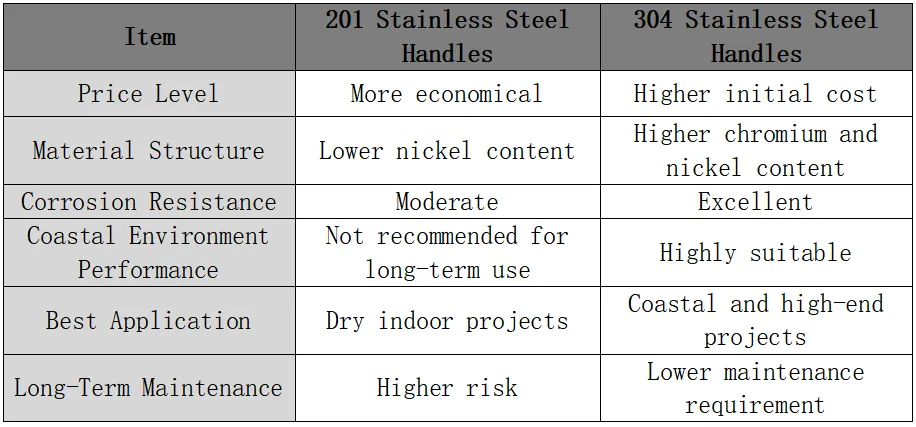
From a short-term purchasing perspective, 201 stainless steel offers cost savings.
However, from a long-term project perspective, 304 stainless steel often provides better overall value because it reduces replacement frequency and after-sales issues.
For furniture hardware exporters, the cheapest material is not always the most cost-effective choice.
5.How to Select Stainless Steel Handles for UAE and South African Markets
Coastal Areas: 304 Stainless Steel Is the Recommended Option
For projects located near the coastline, choosing 304 stainless steel handles is the safer solution.
Examples include:
- Dubai waterfront apartments
- Abu Dhabi seaside villas
- Cape Town coastal residences
- Durban resort furniture projects
These regions face a combination of:
- High humidity
- Salt fog
- Marine atmosphere
- Strong temperature changes
These conditions create continuous corrosion pressure on furniture hardware.
Although 201 stainless steel may appear acceptable during the first few months, long-term exposure can gradually affect the surface quality.
For premium projects and export orders with warranty requirements, 304 stainless steel should be considered the standard choice.
Inland Areas: Choose According to Budget and Project Positioning
In dry inland areas, buyers have more flexibility.
For example, in regions with limited salt exposure, 201 stainless steel handles can be considered for:
- Economy furniture lines
- Large quantity projects
- Cost-sensitive applications
However, for furniture brands that focus on quality positioning, customer experience, and long-term durability, 304 stainless steel remains a stronger option.
The final decision should consider:
- Project location
- Expected product lifespan
- Customer requirements
- Warranty period
- Maintenance costs
6.Important Tips for Bulk Furniture Hardware Purchasing
Selecting the correct stainless steel grade is the first step. Proper quality control during production and shipping is equally important.
(1) Request Material Certification
Because 201 and 304 stainless steel handles have similar appearances, buyers should not rely only on visual checking.
Professional suppliers should provide:
- Material Test Certificate (MTC)
- Stainless steel grade confirmation
- Production batch information
This helps prevent material substitution problems during bulk orders.
(2) Inspect Surface Quality Before Shipment
Before shipping, every batch should be checked carefully.
Important inspection points include:
- Surface scratches
- Polishing quality
- Manufacturing defects
- Uneven finishing
Although stainless steel has strong corrosion resistance, serious surface damage may still create weak points.
(3) Carry Out Salt Spray Testing for Large Projects
For large engineering projects, especially in coastal regions, sample testing before mass production is highly recommended.
Salt spray testing helps buyers confirm whether the actual product meets the expected corrosion resistance requirements.
This step is particularly valuable when working with new suppliers.
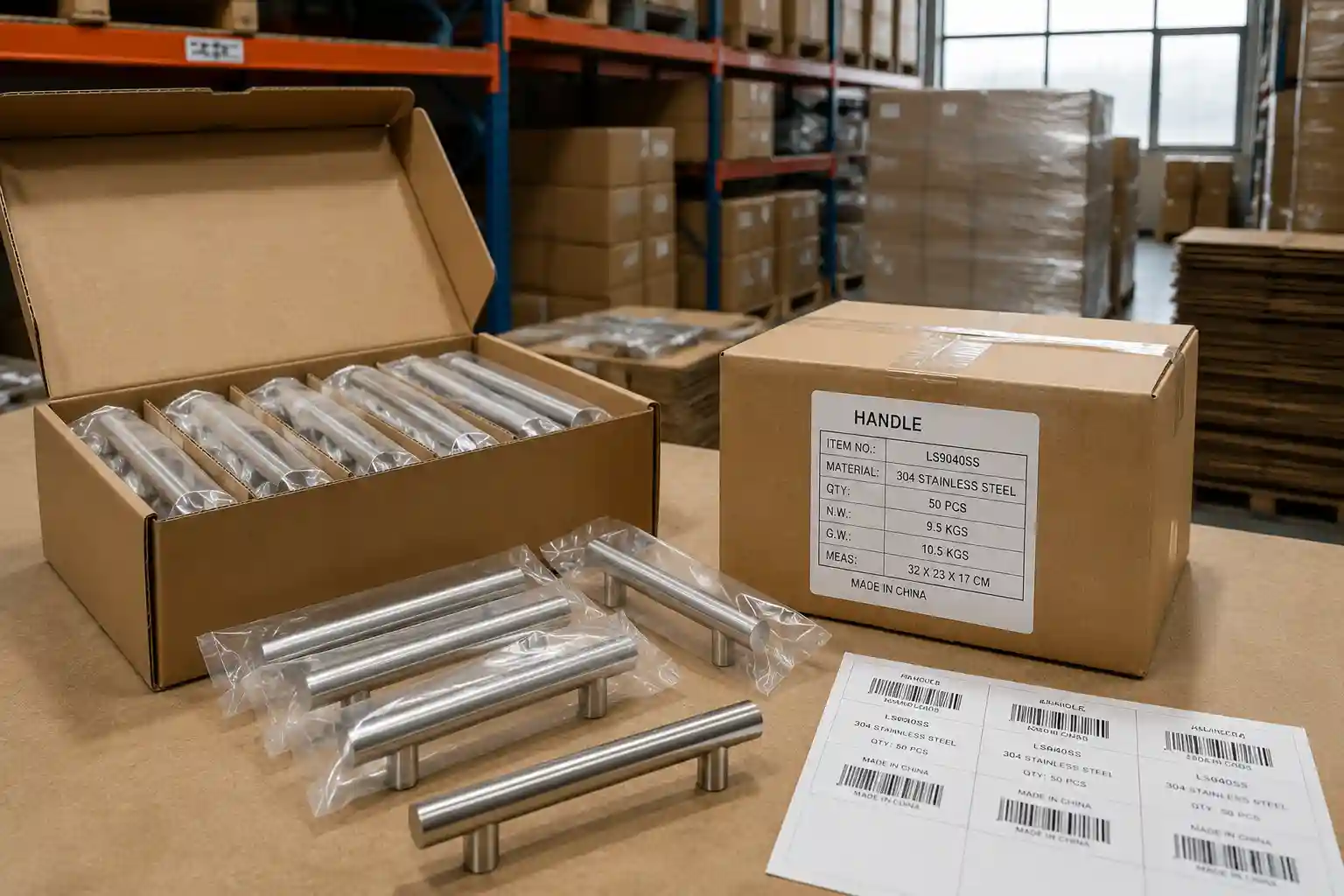
(4) Use Proper Export Packaging
Furniture hardware often travels thousands of kilometers by sea.
During transportation, temperature differences inside containers can create condensation.
To reduce moisture-related risks, suppliers should use:
- Individual protective packaging
- Moisture-proof bags
- Desiccants
- Strong carton protection
Good packaging ensures that products arrive in the same condition as when they leave the factory.
7.Final Thoughts: Choosing the Right Material Creates Long-Term Value
For furniture hardware buyers, selecting between zinc alloy, 201 stainless steel, and 304 stainless steel should never be based only on purchase price.
Different materials are suitable for different environments.
Zinc alloy handles are suitable for cost-focused indoor applications but are not recommended for coastal projects due to higher oxidation risks.
201 stainless steel handles provide a balance between price and performance, making them suitable for dry inland applications.
304 stainless steel handles deliver superior corrosion resistance and long service life, making them the preferred choice for coastal markets, premium furniture, and long-term engineering projects.
For furniture hardware exporters and manufacturers, choosing corrosion resistant furniture hardware helps reduce after-sales problems, improve customer satisfaction, and build stronger market competitiveness.
A reliable handle is not only a small furniture component — it is an important part of the overall product experience and brand value.